Forty and Fresh: How the Modern British Barber Became the Older Gentleman's Best-Kept Secret
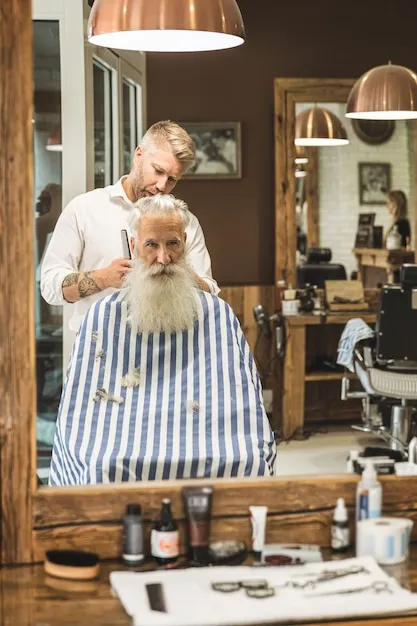
Photo: mature man over 40 getting haircut at traditional British barbershop, via img.freepik.com
There was a time, not so long ago, when a man past forty visited the barber out of obligation rather than ambition. The appointment was a maintenance exercise: a tidy round the ears, a quick once-over with the clippers, and out the door before the kettle had boiled. The haircut itself was an afterthought — something that happened to you, not something you chose.
That era is over. Walk down any high street from Leeds to Leith and you'll find barbershops that treat a gentleman's head the way a Savile Row tailor treats his cloth: with measurement, consultation and quiet respect. And increasingly, the men in those chairs are not twenty-somethings chasing a fade for the 'gram. They are men in their forties, fifties and beyond, who have finally worked out what their hairdresser's daughter knew all along — that the haircut is the highest-leverage grooming decision you will make all year.
Why the Stakes Rise After Forty
A jacket can be swapped. Shoes can be resoled. But your hair is the one element of your appearance you wear every single day, in every photograph, at every meeting, at every wedding and every funeral. After forty, it also becomes the most honest thing about you. Hairlines retreat, greys arrive uninvited, and texture coarsens. Ignore all of this and the haircut dates you. Work with it, and it becomes the sharpest tool in your sartorial arsenal.
"The biggest mistake men make at forty is trying to freeze themselves at thirty-five," says Marcus Dean, who has run a barbershop in Manchester's Northern Quarter for fifteen years. "They want the same cut they had at university. My job is to talk them out of it. A good cut at fifty is not the same cut as a good cut at twenty-five — the architecture has to change with the landscape."
Dean's point is one worth sitting with. The gentleman who clings to a youthful style reads as nostalgic; the one who adapts a classic framework to his current hair reads as considered. The difference, in the chair, is about ten minutes of honest conversation.
The Classics, Reconsidered
The current British barbering revival is not really a revival at all — it is a refinement. The side parting your father wore to the office has been rebuilt with modern scissor work and a lighter hand with the product. The skin fade, once the exclusive territory of the young, has been softened into something remarkably versatile: kept shorter at the sides and longer on top, it lends structure to a face that is beginning to soften, and it makes thinning hair look deliberate rather than defeated.
The pomade revival deserves particular mention. The heavy, shiny, wet-look products of the past have given way to matte clays, styling creams and water-based pomades that offer hold without announcing themselves. For the older gentleman, this is the difference between hair that looks groomed and hair that looks lacquered.
"I tell every client over forty the same thing: less product, more regularly cut," says Priya Nair, a barber in Edinburgh who counts several judges and surgeons among her regulars. "A sharp cut holds its shape for five weeks with almost nothing in it. A poor cut needs half a tub of clay to look acceptable by week three. You're paying for the wrong thing if you're buying product to fix a haircut."
The Consultation Is the Cut
If there is one habit worth adopting from the new generation of British barbering, it is the consultation. The best barbers now ask about your routine, your hat collection, how often you're willing to use a hairdryer, and — crucially — how much grey you're prepared to embrace. This is not small talk. It is the difference between a cut that works on the day and a cut that works for the quarter.
A few questions worth asking at your next appointment:
- How is my hairline actually behaving? A good barber will map the recession and cut to flatter it, not disguise it.
- What does this look like at five weeks? Every cut has a shelf life. Know yours.
- What should I stop doing? Sometimes the most valuable advice is subtractive.
Frequency, Not Fussiness
The final piece of the discipline is regularity. The modern gentleman's barbering calendar is simple: a proper cut every four to six weeks, a beard tidy or hot towel shave in the intervening fortnight if you wear one, and a standing appointment booked before you leave the chair. The cost — typically £25 to £45 in most British cities — is trivial against the return. A £2,000 coat on an neglected head is a wasted £2,000. A £30 haircut under a modest wardrobe elevates everything it touches.
There is something fitting about this, in a very British way. We are a nation that has always understood quiet investment — in cloth, in boots, in tools that last. The barber's chair has simply joined the list. The man who takes it seriously after forty isn't vain. He's just paying attention where it counts most.