Dressed for an Audience of One: Rebuilding Standards When the Commute Disappears
Photo: Bruno ashimwe winks, CC BY-SA 4.0, via Wikimedia Commons
There was a time when the wardrobe had a rhythm to it. Monday through Friday demanded a certain presentation; Saturday and Sunday allowed a loosening of the collar. That structure, for all its rigidity, did a man a quiet service: it made getting dressed a decision that had already been made.
Then the commute evaporated. The suit stayed on its hanger. The good shoes gathered dust by the door. And somewhere between the kitchen table and the spare room desk, a great many British men stopped dressing for anyone at all.
The Waist-Up Trap
The most common failure of the home-working wardrobe is what we might call the waist-up trap. A presentable shirt on the top half — chosen because it will appear on a video call — and beneath the desk line, a state of affairs best not described in a family publication.
It seems like a sensible compromise. It isn't. The problem is not that anybody sees your joggers; it is what the arrangement does to your own head. Clothes are not merely decoration. They are a signal to yourself about what the day is for. A man in a pressed shirt and lounge trousers is playing at work from the neck up only, and he tends to work like it too.
The fix is not a full suit at the kitchen table — that would be theatre, and theatre is exhausting. The fix is dressing entirely, if modestly, from head to toe. Proper trousers that happen to be comfortable. Shoes, or at the very least slippers with some dignity about them.
The Comfort-Quality Trade-Off
The second great error is the belief that comfort and quality are opposing forces. The high street has been only too happy to exploit this, selling men the idea that working from home means a wardrobe of marled grey cotton and elasticated waists.
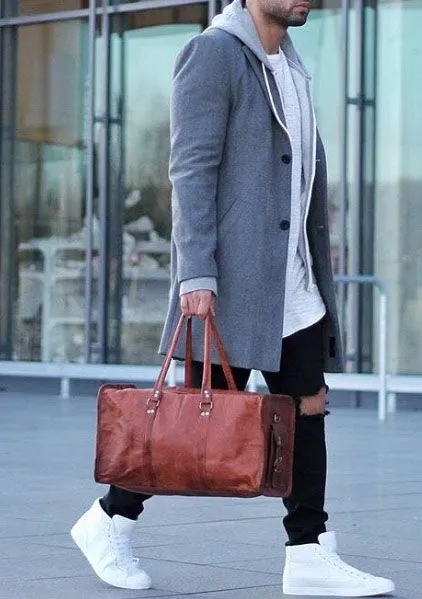
In truth, comfort is a function of fabric and fit, not sloppiness. A pair of merino trousers is softer than any jogger and looks infinitely better. A well-cut loopback sweatshirt outperforms a shapeless hoodie on every measure. A fine-gauge knit over a tee is as easy to wear as anything sold in a multipack, and it will still look respectable when you step out for a sandwich at half past one.
The rule of thumb: buy clothes that would not embarrass you at the corner shop, and you will never be embarrassed at your own desk either. Because you will go to the corner shop. That is the other thing about working from home — the boundary between indoors and out dissolves by Wednesday.
Fewer Clothes, Better Ones
Here is the counterintuitive arithmetic of the commute-free life. You might assume that abandoning the office means needing less. You do need less — but what you need is better.
The old wardrobe was built around repetition: five shirts, five pairs of trousers, a rotation that nobody saw the point of questioning. The new wardrobe should be built around versatility. A handful of pieces that work at the desk, at the school gates, at the pub when the afternoon meeting ends early.
Think in terms of a small working kit: two or three merino or cotton knitwear pieces in colours that co-operate with one another; two pairs of trousers — one smarter, one more relaxed, neither made of jersey; a good overshirt or an unstructured jacket for the colder months and the dash outdoors; footwear that can survive both the video call and the school run.
This is not a capsule wardrobe in the Instagram sense. It is simply an honest reckoning with how you actually spend your days, which is something the office wardrobe never had to be.
A Framework, Not a Uniform
Some men respond to all this by inventing elaborate systems — dress codes for the home office, tiered by the importance of the day's meetings. This is overthinking it. What is needed is not a uniform but a floor: a minimum standard below which you do not sink, regardless of what the calendar says.
Ours would read as follows. Nothing you would sleep in. Nothing you would wear to paint a shed. At least one layer that isn't a t-shirt. And a full outfit — both halves — before the first call of the day.
That is it. It costs nothing, takes ninety seconds, and it preserves something the past three years have quietly eroded: the sense that a man gets dressed for the day, not merely for the camera.
The office may be optional. The standards, gentlemen, are not — or at least, they shouldn't be. The man who gets dressed properly at home has made a small daily argument that his work, and by extension he himself, is worth the effort. In an age when nobody is checking, that argument is worth making to yourself.